
When purchasing or specifying galvanized steel sheets, the single most critical factor determining outdoor lifespan isn’t the thickness of the steel base—it’s the weight and thickness of the zinc coating.
Zinc coating weight directly dictates how many years a sheet will resist rust before the underlying steel is exposed. However, navigating industry designations like G30, G60, G90, Z180, or Z275 can be confusing because the market uses two different measurement systems: Imperial (ASTM) and Metric (ISO/EN).
1. Imperial vs. Metric Coating Designations
The zinc coating designation indicates the total mass of zinc applied to both sides of the sheet combined.
ASTM Standards (Imperial: “G” Designations)
In North America and many international markets using ASTM A653 specifications, coating weight is measured in ounces per square foot ($text{oz/ft}^2$) total on both sides.
-
G60: $0.60text{ oz/ft}^2$ total zinc ($0.30text{ oz/ft}^2$ per side).
-
G90: $0.90text{ oz/ft}^2$ total zinc ($0.45text{ oz/ft}^2$ per side).
-
G115: $1.15text{ oz/ft}^2$ total zinc ($0.575text{ oz/ft}^2$ per side).
ISO / EN Standards (Metric: “Z” Designations)
In Europe, Asia, and international markets following EN 10346, coating weight is measured in grams per square meter ($text{g/m}^2$) total on both sides.
-
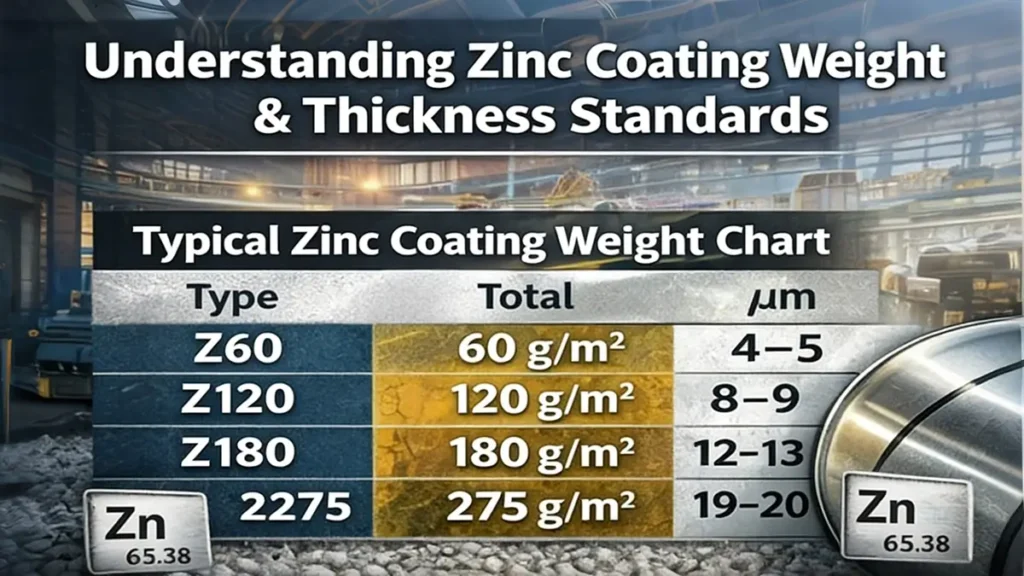
Z180: $180text{ g/m}^2$ total zinc ($approxtext{G60}$).
-
Z275: $275text{ g/m}^2$ total zinc ($approxtext{G90}$).
-
Z350: $350text{ g/m}^2$ total zinc ($approxtext{G115}$).
2. Converting Coating Weight to Actual Thickness (Microns)
While buying specs list weight ($text{oz/ft}^2$ or $text{g/m}^2$), field contractors and quality inspectors measure actual thickness on one side using a magnetic thickness gauge in microns ($mutext{m}$) or mils.
Because the density of zinc is approximately $7.14text{ g/cm}^3$, you can use a quick conversion formula:
$$text{Thickness per side }(mutext{m}) = frac{text{Total Zinc Weight }(text{g/m}^2)}{2 times 7.14}$$
Coating Weight to Thickness Reference Table
|
ASTM Spec (Imperial) |
EN Spec (Metric) |
Total Zinc Weight (Both Sides) |
Thickness Per Side (μm) |
Common Applications |
|
G30 |
Z100 |
$0.30text{ oz/ft}^2$ ($100text{ g/m}^2$) |
$approx 7 mutext{m}$ |
Dry indoor panels, light ductwork |
|
G60 |
Z180 |
$0.60text{ oz/ft}^2$ ($180text{ g/m}^2$) |
$approx 13 mutext{m}$ |
Interior framing, light outdoor sheds |
|
G90 |
Z275 |
$0.90text{ oz/ft}^2$ ($275text{ g/m}^2$) |
$approx 20 mutext{m}$ |
Commercial roofing, agricultural panels |
|
G115 |
Z350 |
$1.15text{ oz/ft}^2$ ($350text{ g/m}^2$) |
$approx 25 mutext{m}$ |
Heavy industrial, high-humidity roofing |
|
G210 |
Z600 |
$2.10text{ oz/ft}^2$ ($600text{ g/m}^2$) |
$approx 42 mutext{m}$ |
Highway guardrails, extreme exposure |
3. Estimating Expected Outdoor Service Life
Because zinc corrodes at a predictable linear rate depending on atmospheric moisture and chemical exposure, thickness directly calculates lifespan to first major rust.
General Corrosion Rates of Zinc in Atmosphere:
-
Rural / Low Humidity: $0.2text{ to }0.5 mutext{m per year}$
-
Urban / Light Industrial: $1.0text{ to }2.0 mutext{m per year}$
-
Marine / Coastal Spray: $2.0text{ to }5.0+ mutext{m per year}$
Calculated Lifespan Example (G90 / Z275 in Urban Environment):
─────────────────────────────────────────────────────────────
• Zinc Thickness per side = 20 µm
• Annual Zinc Loss Rate = 1.5 µm/year
• Estimated Years to Rust = 20 µm ÷ 1.5 µm/year ≈ 13.3 Years
4. Practical Purchasing Advice for Contractors
-
Avoid G30/G40 for Outdoor Use: Never use G30 or G40 for exterior roofing or wall panels. These light coatings will show red rust within 2–5 years of atmospheric exposure.
-
Require Mill Test Certificates (MTC): Always ask suppliers for MTCs to verify the actual zinc coating weight. Sub-standard sheets sold as “commercial grade” often drop below G40 levels.
-
Account for Forming Wear: Bending sheets on a press brake slightly stretches the outer zinc surface. Specify G90 (Z275) minimum for corrugated or roll-formed roofing profiles to ensure post-bending edge protection.
Aluminium Sheet Kampala Uganga