
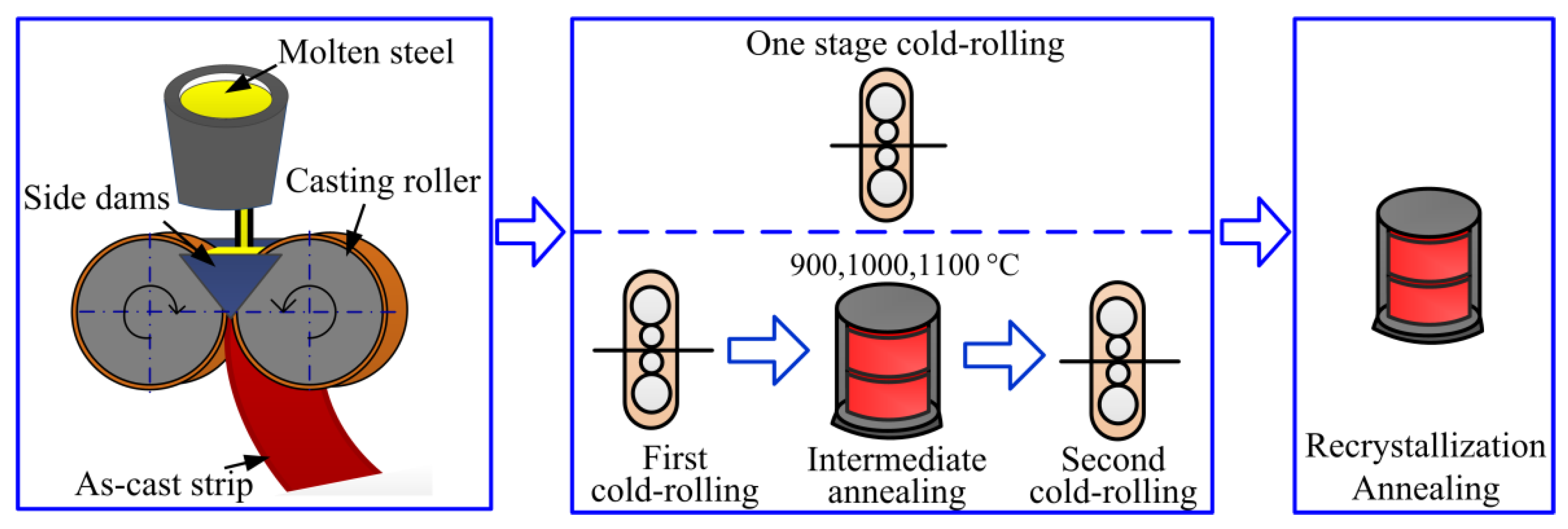
Cold rolling constitutes the foundational mechanical process used to transform thick, hot-rolled aluminium or steel re-roll stock into thin, highly uniform engineering sheets. Conducted below the metal’s absolute recrystallization temperature—typically at room temperature—cold rolling alters both the dimensional profile and the internal crystallographic structure of the sheet. By subjecting the material to extreme compressive loads applied by rotating hardened steel rolls, the process achieves precise thickness reductions, improves surface smoothness, and systematically elevates mechanical strength through work hardening (strain hardening).
-
Work Rolls & Backup Rolls Architecture
-
-
[ Upper Backup Roll ]
-
|
-
v
-
( Upper Work Roll )
-
||
-
Incoming Strip ==================||================== Outgoing Strip
-
(Thicker Gauge) || (Reduced Gauge)
-
( Lower Work Roll )
-
^
-
|
-
[ Lower Backup Roll ]
The Physics of the Roll Bite and Plastic Deformation
The primary plastic deformation zone during sheet rolling is known as the “roll bite.” As the metal strip enters the contact zone between opposing work rolls, it is drawn inward by frictional forces acting across the roll-sheet interface. The geometry of the roll bite is governed by the contact length ($L_c$), the initial strip thickness ($h_0$), the exit strip thickness ($h_1$), and the effective radius of the work rolls ($R$):
$$L_c = sqrt{R cdot (h_0 – h_1)}$$
Because the volume flow rate of the metal must remain constant throughout the reduction pass (governed by the law of conservation of mass), the velocity of the strip changes continuously as it traverses the roll bite. As the strip thickness decreases, its linear velocity increases from entry speed ($v_0$) to exit speed ($v_1$). Consequently, there exists a single specific point along the arc of contact where the linear surface velocity of the rotating work roll precisely matches the speed of the moving strip. This critical geometric location is known as the neutral point or no-slip point.
-
Stress Distribution in the Roll Bite
-
-
Entry (v0 < v_roll) Exit (v1 > v_roll)
-
/
-
/
-
Incoming Sheet ———> [ Neutral Point ] ———> Outgoing Sheet
-
(v_sheet = v_roll)
-
|
-
[ Peak Friction Hill ]
Upstream of the neutral point (toward the entry side), the work roll moves faster than the strip, creating frictional forces that drag the metal forward into the roll bite. Downstream of the neutral point (toward the exit side), the accelerating strip moves faster than the work roll surface, causing frictional forces to oppose the forward motion of the sheet. This opposing frictional action generates an internal compressive stress peak within the deformation zone known as the friction hill. Tightly managing this friction hill through specialized rolling lubricants—typically synthetic ester-based emulsions or highly refined mineral oils—is essential. Insufficient lubrication increases roll wear, drives up mill power consumption, and causes surface tearing; conversely, excessive lubrication leads to roll slip, hydrodynamic floating, and loss of dimensional control.
Crystallographic Slip and Dislocation Multiplication Dynamics
The mechanical strengthening that occurs during cold rolling is governed by dislocation dynamics within the crystal lattice. In face-centered cubic ($text{FCC}$) metals like aluminium and body-centered cubic ($text{BCC}$) metals like ferritic steel, plastic deformation occurs via crystallographic slip along dense atomic planes. As the compressive forces of the work rolls exceed the material’s critical resolved shear stress ($tau_{crss}$), line defects (dislocations) begin to glide across active slip systems.
-
Dislocation Entanglement and Cell Structure
-
-
Initial Low Dislocation Density Cold-Worked High Dislocation Density
-
+—————————–+ +—————————–+
-
| | | | | / / / # # # # # / / / / / |
-
| | | | —–> | # # Subgrain Boundary # # |
-
| | | | | | / / / # # # # # / / / / / |
-
+—————————–+ +—————————–+
-
(Soft / Ductile) (Work-Hardened / High Strength)
As strain accumulation progresses during successive rolling passes, several key microstructural changes take place:
-
Dislocation Multiplication: Existing dislocations multiply rapidly via Frank-Read sources, causing overall dislocation density to rise exponentially—from approximately $10^6text{ to }10^8 text{ cm}^{-2}$ in the annealed state up to $10^{11}text{ to }10^{12} text{ cm}^{-2}$ in heavily cold-worked sheets.
-
Dislocation Interaction and Tangling: As millions of dislocations move across intersecting slip planes, they collide, interlock, and form dense dislocation tangles and jog networks. These tangles act as internal barriers that impede the motion of subsequent dislocations.
-
Subgrain Cell Formation: At higher strain levels, dislocations rearrange themselves into dense arrays that enclose relatively dislocation-free regions, forming a distinct subgrain cell structure.
To continue deforming the work-hardened material, higher shear stresses must be applied to force dislocations through these dense structural tangles. On a macroscopic scale, this microscopic lattice resistance manifests as a sharp increase in yield strength ($sigma_y$) and ultimate tensile strength ($sigma_{uts}$), accompanied by a proportional decrease in total elongation and formability.
Four-High and Cluster Mill Configurations
To achieve thin gauges without causing high elastic deflection across the work rolls, modern cold rolling plants utilize multi-roll mill stands. Applying high compressive forces to small-diameter work rolls reduces the overall contact area, lowering the total rolling load required to deform the sheet. However, thin work rolls are susceptible to flexural bending, which would cause the sheet to be thicker in the center than at the edges (a defect known as a crown).
-
Multi-Roll Stand Configurations
-
-
4-High Mill Stand 6-High Mill Stand
-
[ Upper Backup Roll ] [ Upper Backup Roll ]
-
| |
-
( Upper Work Roll ) ( Upper Intermediate Roll )
-
===================== =============================
-
( Lower Work Roll ) ( Upper Work Roll )
-
| =======================
-
[ Lower Backup Roll ] ( Lower Work Roll )
-
=============================
-
( Lower Intermediate Roll )
-
|
-
[ Lower Backup Roll ]
To prevent roll flexure, cold rolling stands employ stiff backup roll systems:
-
4-High Mill Stands: Feature two small-diameter work rolls supported above and below by large-diameter forged steel backup rolls that absorb heavy vertical thrust loads.
-
6-High Mill Stands: Integrate intermediate axially shifting rolls between the work rolls and backup rolls. Shifting these contoured intermediate rolls compensates for elastic roll deflection across varying sheet widths.
-
20-High Cluster Mills (Sendzimir Mills): Utilize a central pair of micro-diameter work rolls surrounded by a cluster of secondary and tertiary supporting rolls. This layout delivers extreme dimensional precision when cold rolling ultra-thin gauges, stainless steels, and hard aluminium alloys.
Automatic Gauge and Flatness Control Systems
Maintaining uniform thickness (gauge) and profile flatness across the entire length and width of a coil moving at high speed requires automated feedback loops. Modern cold rolling mills integrate real-time sensor technologies to control sheet geometry:
-
Closed-Loop Gauge Control Loop
-
-
X-Ray Gauge Sensor ———-> Controller / Process CPU
-
^ |
-
| v
-
[ Moving Sheet ] <———- Hydraulic Screwdown Actuator
-
Automatic Gauge Control (AGC): Non-contact X-ray or isotope thickness gauges measure the strip thickness at the entry and exit of each mill stand. If thickness deviations occur, high-speed hydraulic screwdown cylinders adjust the gap between the work rolls within milliseconds, or dynamic tension winches alter entry/exit strip tension to adjust the flow stress of the material.
-
Automatic Flatness Control (AFC): Non-uniform reduction across the strip width creates internal residual stresses, leading to shape defects such as edge waves (longer edges) or center buckles (longer middle). To correct these anomalies, segmented air-bearing measurement rolls detect local pressure variations across the strip width. A process computer processes these signals and dynamically triggers localized work-roll bending cylinders, or activates targeted coolant spray zones to thermally expand or contract specific regions of the work rolls.
Through these combined mechanical, metallurgical, and dynamic control frameworks, cold rolling transforms raw metallic stock into highly engineered, work-hardened sheets with micro-scale dimensional accuracy.
Aluminium Sheets Kigali Rwanda